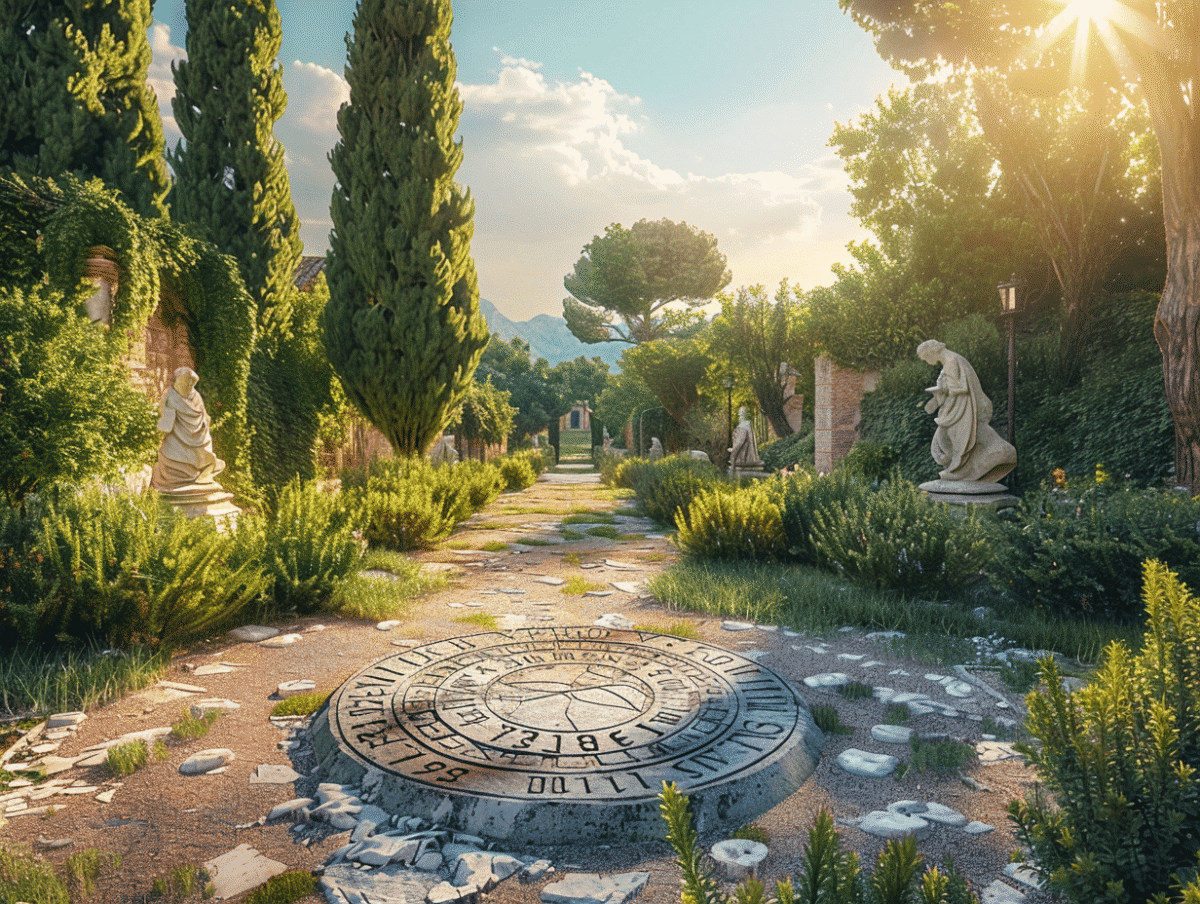
For centuries, Roman numerals have been the cornerstone of numbering in the Western world, playing a key role in various aspects of society, including the structuring of our calendar. The adoption of Roman numerals allowed for a standardization of dates and periods, facilitating the organization of events and agricultural planning. Their complexity also posed challenges, particularly in the calculations necessary for calendar reforms. The shift to Arabic numerals marked a significant advancement, simplifying calculations and allowing for more precise adjustments, leading to our modern calendar system.
The impact of Roman numbering on the structuring of time
Roman numerals, a numbering system using letters from the Latin alphabet, left their mark on ancient Rome and, by extension, all of Antiquity. Invented by the Romans, this system was not only a means of writing but also a tool for structuring time and organizing social and religious life. The Roman calendar, with its ides, nones, and calends, was inextricably linked to this classical notation. Symbols such as I, V, X, or ‘IV in Roman numeral’ were not only carved in the marble of monuments like the Pont du Gard but also embedded in the collective consciousness of this civilization, dictating the rhythm of daily activities and ceremonies.
Modifying the code of Roman numerals to meet the needs of the time was often a complex task, as the Romans inherited the Etruscan system and adapted it for their own purposes. Innovations, such as the introduction of the subtractive rule to reduce the number of consecutive symbols (for example, writing ‘IV’ instead of ‘IIII’), reflected an attempt to evolve the notation. The complexity of this system ultimately highlighted the limitations of Roman numbering, particularly when it came to calculating and predicting essential astronomical or seasonal events for the calendar.
Despite these constraints, the legacy of Roman numerals remains undeniable. The Romans helped shape our understanding of time and its division, influencing future generations. The Julian calendar, established by Julius Caesar and which prevailed for over a millennium, relied on the numbering system of the time to define years, months, and days. While today Arabic numerals have replaced the classical notation, the Romans’ imprint on our structuring of time remains a fundamental component of our cultural and historical heritage.
Roman numbering and its legacy in modern calendar systems
Roman numerals have traversed the centuries, leaving an indelible mark on the dating systems we still use today. Although the Julian calendar, instituted by Julius Caesar, has been replaced by the Gregorian calendar, we find this influence in the nomenclatures of centuries and millennia. Historical monuments, churches, and even the preambles of certain international treaties continue to engrave dates in Roman numerals, testifying to the durability of this notation.
In cultural institutions such as the Carnavalet Museum and the Louvre, the presence of Roman numerals remains palpable. An evolution is on the horizon. These museums plan to modify their numbering code by gradually phasing out Roman notation in favor of Arabic numerals, which are more familiar to the general public and deemed more practical for understanding and international communication.
This transition to a standard notation reflects an adaptation to contemporary demands for clarity and universality. The subtractive rule, characteristic of Roman numbering with examples like ‘IV’ for four or ‘IX’ for nine, while ingenious, clashes with the efficiency needs of our digital age. Despite these changes, the terms ‘Kalendae’, ‘Idus’, and ‘Nonae’ remain embedded in the language, reminding us of the key days of the Roman calendar and highlighting the historical influence of this civilization on modern conceptions of time.