
Used both in popular streets and during family exchanges, this phrase highlights how certain expressions cross social and generational boundaries. Rarely questioned about its exact origin, it remains loaded with cultural and historical nuances.
Its use, far from being trivial, often serves to seal the truth of a statement or to reinforce a moral commitment. Despite its grounding in everyday language, its interpretation varies according to contexts and interlocutors, revealing sometimes contradictory usages.
Wallah Lahdim: where does this expression come from and what does it really mean?
Behind wallah lahdim, there is a living heritage from the Maghreb and popular Arabic. The structure is simple: wallah, “by God,” and lahdim, a popular version of al-‘adhim (“the Majestic”). This oath, “I swear by Allah the Majestic,” genuinely commits the speaker. Here, the phrase does not merely support a simple opinion: it invokes the sacred dimension, faith, and honor as guarantees of sincerity.
However, the meaning of wallah has largely transcended the strict religious framework. While Islamic prescriptions surround this oath with a certain gravity, the street has adopted, transformed, and popularized it. Wallah lahdim is now as much a code of popular language in the Maghreb as it is a marker of belonging in French suburbs. Sometimes stripped of its solemn weight, sometimes used lightly, it still carries a certain significance depending on the context. The graphic variants, wallahi, wlh, whl, demonstrate the vitality of the expression and its ability to reinvent itself from generation to generation.
To grasp all the nuances of this phrase, one only needs to consult the definition of wallah lahdim, which details its meanings and the ways it has evolved. Between the solemnity of the oath and the spontaneity of everyday life, wallah lahdim condenses traditions, identity, and the relationship to speech. Whether in the Maghreb or among diasporas, it remains an oral pact, where the promise engages faith and honor.
Between solemn oath and everyday language: the multiple uses of Wallah Lahdim
Wallah lahdim circulates well beyond its lands of origin. Born from the Maghreb, it has established itself as a rallying cry of popular language among youth from immigrant backgrounds in France. It is heard in discussions, found in French rap, and displayed on social media. Sometimes a promise, sometimes a guarantee of sincerity, sometimes just a verbal reflex, the expression adapts to all uses, from the most solemn to the most mundane.
The meaning of wallah lahdim depends on the situation. In a family or friendly circle, it reinforces the word, reminding of the seriousness of a commitment even if the conversation remains light. In the religious register, the phrase retains its seriousness; it engages before God, and Islam warns against any trivialization. Figures like Shaykh Ibn Bâz or Shaykh al-‘Uthaymîn remind us that multiplying oaths risks a major sin.
The same expression thus weaves through all registers: from the formal context, where it seals a promise that engages honor, to informal speech, where it punctuates the narrative of an ordinary fact. In writing, it appears in the form of abbreviations, wlh or whl, in digital exchanges. This transition from the sacred to the profane raises a real question: what is the value of a given word today, when the oath becomes a speech tic? Even when used casually, the phrase continues to act as a reminder of honor, of the link between word and identity.
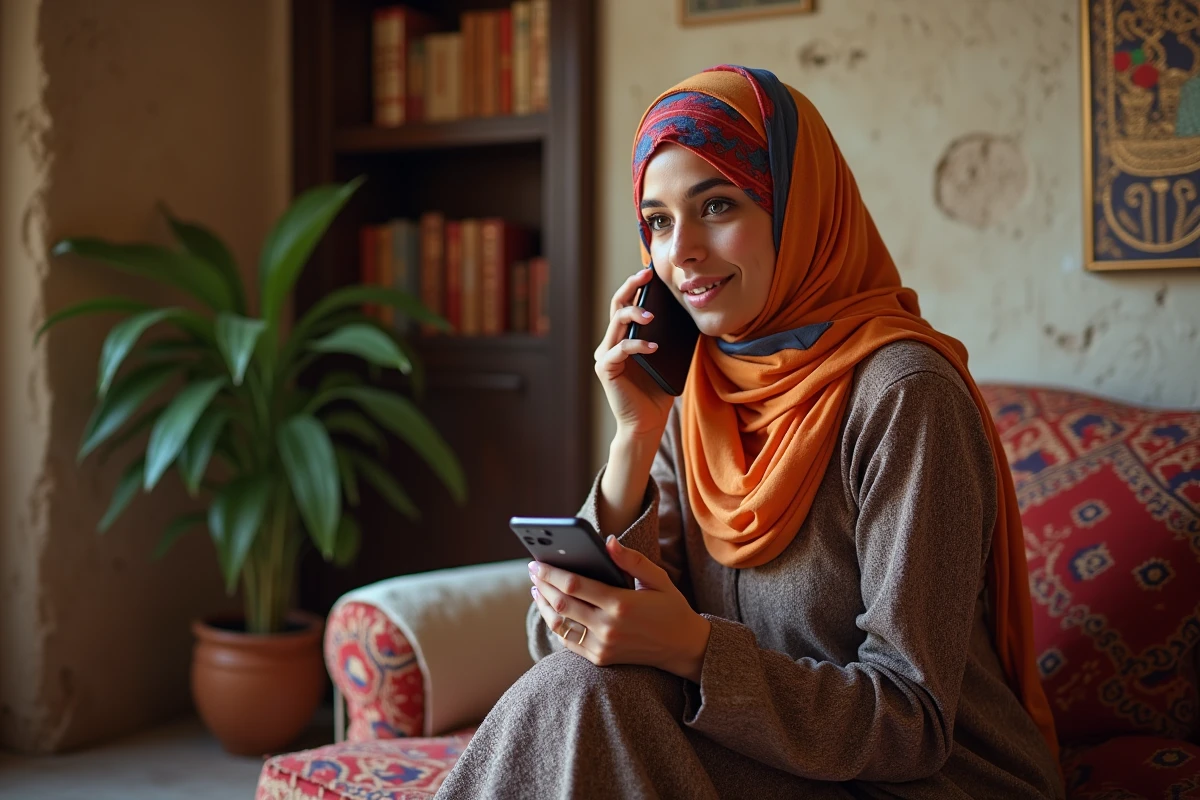
When and how to use Wallah Lahdim today? Concrete examples and usage tips
The use of wallah lahdim follows a simple rule: to affirm one’s sincerity without devaluing the meaning of the oath. For a long time, it was only pronounced to settle a serious debate or mark a deep disagreement. Today, the phrase has entered informal conversations, sometimes to reassure a loved one, sometimes just to give weight to a statement.
In the religious context, one cannot afford to be light-hearted. Pronouncing the name of Allah implies a moral responsibility: the phrase is not used for just any detail. It is brought out during serious family disputes or when trust is at stake before an official body, but not at every turn. Conversely, multiplying “wallah lahdim” for trivial matters ends up diminishing its meaning, and many see it as a dilution of the sacred.
For those who wish to express their good faith without resorting to the religious register, other formulations exist: “I promise you,” “for real,” or, more familiarly, “I assure you.” Arabic expressions like insha’Allah, mashallah, or bismillah each have their own specific usage: expectation, admiration, or the initiation of an action.
Here are two recommendations for using wallah lahdim wisely:
- Reserve wallah lahdim for moments when trust or honesty are genuinely at stake, or in the face of a serious accusation.
- Avoid using it mechanically in everyday conversation, in order to maintain its full impact.
Public figures like Khabib Nurmagomedov or Mohamed Salah use it, and the expression circulates on social media as well as in the media. Each time, it reminds us that in just a few words, a whole vision of speech, identity, and fidelity is expressed. One does not swear in vain: behind the phrase, it is the value of commitment that is at stake, each time it crosses the lips.