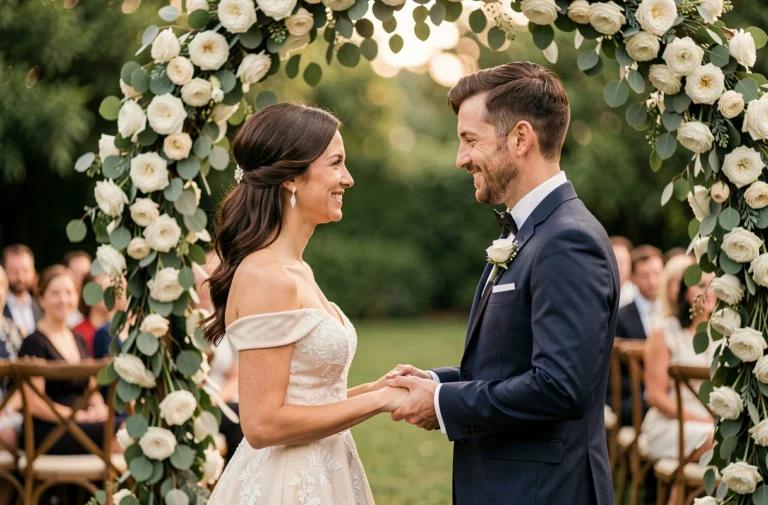
In the celebration of a civil marriage, every moment carries a special significance, reflecting the commitment of two individuals to one another before society. The procedure generally begins with the declaration of intent, where the future spouses express their desire to marry. The publication of the banns is then carried out, ensuring the transparency of the union. On the big day, the ceremony takes place at the town hall, often presided over by the mayor or an assistant. The exchange of consent constitutes the heart of the event, followed by the signing of the registers, an act that legally seals the union. This series of steps, imbued with formality and emotion, formalizes the mutual commitment of the spouses.
The preparations for the civil marriage: steps and organization
The civil marriage, before being a ceremony, is a procedure governed by specific administrative steps. The future spouses must first compile a marriage file, which will include, in particular, a recent birth certificate for each and, if applicable, a marriage contract established before a notary. The required documents may vary depending on the particular situations of the partners; a prior consultation with the civil status officer may prove wise to clarify these specific needs.
Once the file is complete, it is submitted to the town hall where the civil ceremony will take place. This submission of the marriage file marks the beginning of the official countdown, preceding the publication of the banns. The law mandates this publication to inform the community of the intention to marry and allow for any possible objections. This step, often perceived as a mere formality, is nonetheless essential for the validity of the union.
The celebration of the marriage at the town hall, orchestrated by the civil status officer, often the mayor or one of his assistants, will include the traditional mayor’s speech for a wedding. This solemn moment is an opportunity to remind the rights and duties of the spouses, but also to personalize the event by mentioning, for example, their story or their commitments.
The civil marriage must be formalized at the town hall to be recognized. It is a formality that concludes the ceremony. At the end of the exchange of consent and rings, the newlyweds sign the marriage certificate, just like the witnesses and the civil status officer. The family record book is then handed to the spouses, a document attesting to their new situation and their family ties now governed by civil law.

The big day: ceremony and formalities at the town hall
The civil marriage ceremony, a key moment of the union, takes place within the walls of the town hall, an emblematic place of the exercise of citizenship and the affirmation of civil ties. The future spouses, surrounded by their loved ones and witnesses, present themselves before the civil status officer, often represented by the mayor or his representative, to formalize their commitment. The wedding hall then becomes the stage for a republican ritual where the values of the municipality and the nation are celebrated.
The ceremony begins with the reading of the articles of the civil code relating to the rights and duties of spouses. This reading, far from being a mere formality, anchors the commitment in a legal and symbolic framework. Then comes the solemn moment when the future spouses, now husband and wife, express their mutual consent, the cornerstone of the institution of marriage. Consent, exchanged freely and knowingly, is the sine qua non condition for the validity of the union.
Following this affirmation of will, the exchange of rings materializes the commitment made and seals the agreement of hearts and minds. This gesture, laden with history and symbolism, testifies to the desire to build a shared life under the sign of fidelity and solidarity. Each ring, worn on the ring finger, becomes the visible and daily sign of the marital bond.
After the exchange of consent and rings, the signing of the marriage certificate by the spouses and their witnesses officializes the union. The civil status officer also affixes his signature, thus ensuring the compliance of the procedure. The family record book, handed to the spouses at the end of the ceremony, completes the formalities. It constitutes an essential document attesting to the union and paving the way for future family events. This act, beyond its administrative nature, carries a deeply personal and symbolic dimension for the spouses.