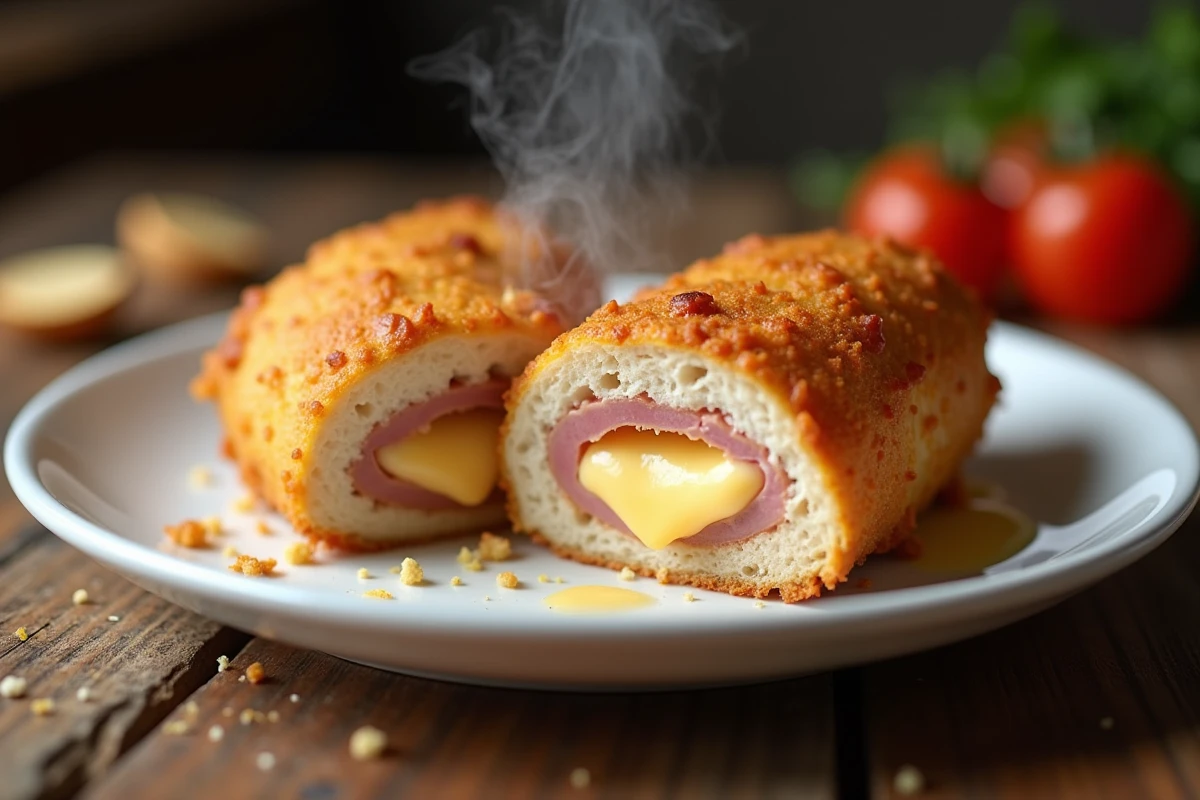
The breaded cordon bleu, whether industrial or homemade, relies on a fragile assembly: a layer of breadcrumbs, a thin escalope of chicken or turkey, and melted cheese at the center. The microwave heats by agitating water molecules, which produces steam inside the breading itself.
This steam softens the breadcrumbs instead of dehydrating them as an oven or frying pan would. Understanding this mechanism allows you to adapt your technique to achieve an acceptable, even satisfying result without turning on the oven.
Why the breading of the cordon bleu softens in the microwave
The breadcrumbs of a cordon bleu owe their crispy texture to surface dehydration achieved through dry heat. An oven or frying pan evaporates moisture outward from the product. The microwave does the opposite: it generates steam from the core of the food, and this steam migrates to the surface.
Result: the breading absorbs moisture instead of losing it. The breadcrumbs become soft, sometimes rubbery. The inner cheese, rich in water, exacerbates the phenomenon by releasing a lot of steam within the first few seconds of heating.
This is not a defect of your appliance. It is a physical limitation of microwave cooking, which produces no Maillard effect or surface caramelization. Knowing the cooking time for cordon bleu in the microwave is useful, but managing moisture is just as important as the duration.

Power setting and cooking time in the microwave for cordon bleu
Most users start the microwave at full power. For a pre-cooked or cooked cordon bleu, this is the main mistake. Too high a power overheats the peripheral areas before the core is hot, causing localized excess steam.
Recommended power
Reducing the power to 50-60% of the maximum slows the temperature rise and allows for more even heat distribution throughout the thickness of the product. The cheese melts gradually without exploding out of the breading.
Duration according to the type of cordon bleu
- A pre-cooked cordon bleu (leftover meal) requires a short reheating, about one to two minutes at medium power, flipping it halfway through.
- A frozen pre-cooked cordon bleu requires more time: start with a short defrosting phase at low power, then slightly increase for the actual reheating.
- A raw cordon bleu is not suitable for the microwave alone. Cooking the core remains uncertain, and the health risk is real (see next section).
Flipping the cordon bleu halfway through cooking limits the typical cold spots of the microwave, where heat does not penetrate evenly.
Food safety: core temperature and risk of salmonellosis
ANSES published an opinion on July 12, 2022, reminding that breaded poultry products, even sold as “pre-cooked,” remain risky matrices if the core does not reach a sufficient temperature during reheating. The microwave, due to its uneven heat distribution, can leave cold spots inside the product.
These cold spots allow bacteria like salmonella to survive reheating. Several recall campaigns for breaded poultry products took place between 2022 and 2023, leading manufacturers to modify their packaging to explicitly mention that the microwave is not recommended or reserved for simple reheating.
To limit this risk, checking the temperature at the center of the cordon bleu with a kitchen thermometer remains the most reliable method. The core should be thoroughly hot, with no lukewarm areas. In case of doubt about a frozen product, finishing in a frying pan or oven after microwaving eliminates the problem.
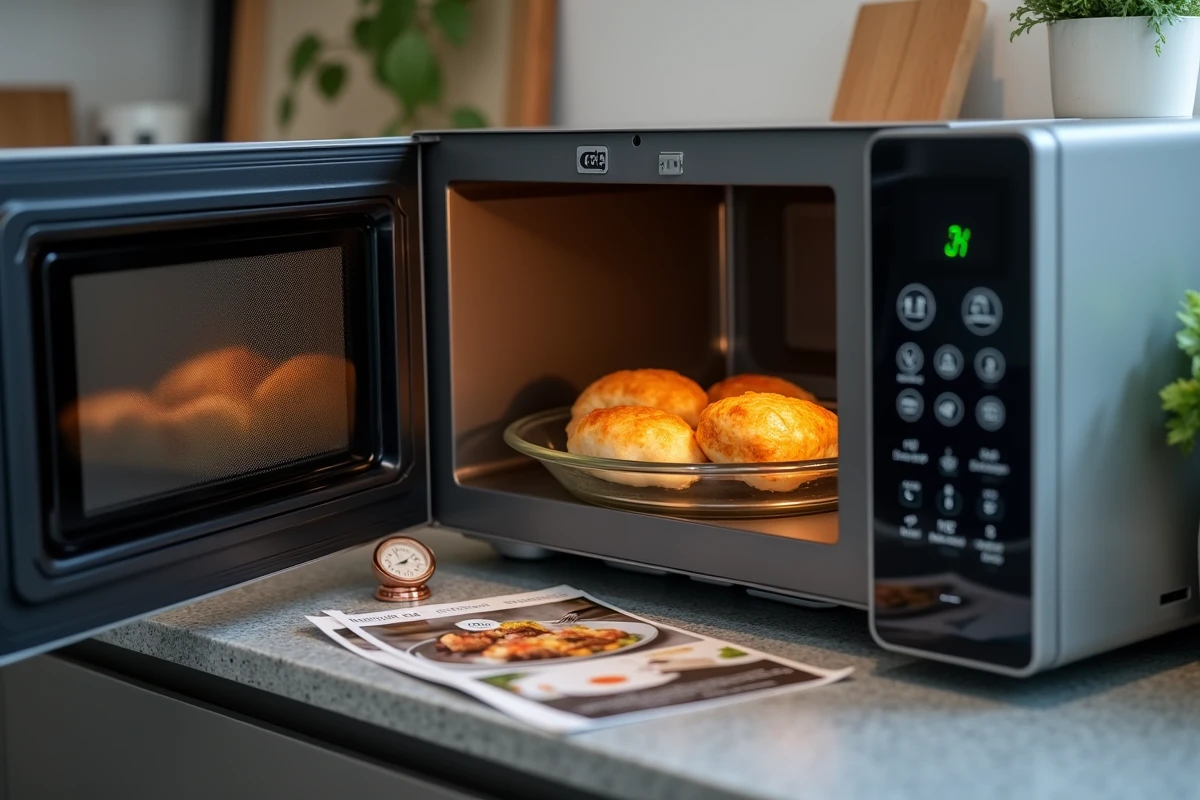
Hybrid microwave and frying pan method for a crispy cordon bleu
Using the microwave only to heat the core, then finishing with dry heat, provides the best compromise between speed and texture. The logic is simple: the microwave quickly heats the inside, while the frying pan restores crispiness to the outside.
Concrete steps
Place the cordon bleu on a suitable plate, without covering it tightly (a paper towel placed on top absorbs some of the steam). Reheat at medium power for about a minute, just enough for the cheese to start melting.
Heat a frying pan with a drizzle of oil or a knob of butter. Place the cordon bleu from the microwave in it and sear for one to two minutes on each side, until the breadcrumbs become golden and crispy again.
This method takes a few more minutes than using the microwave alone, but it preserves the texture of the breading while ensuring a well-melted cheese core. For busy families with children, it’s a realistic compromise between using the microwave entirely and cooking fully in the oven.
Common mistakes that ruin reheating the cordon bleu
Covering the cordon bleu with plastic wrap or a tight lid in the microwave traps all the steam against the breading. The result resembles more of a steamed cordon bleu than a breaded product. A simple paper towel placed on top is enough to limit splatter without trapping moisture.
Stacking multiple cordon bleus in the microwave creates uneven cooking zones. Reheating one cordon bleu at a time ensures more uniform heat. If the quantity requires it, it’s better to switch to the oven for multiple portions.
Restarting the microwave “for another thirty seconds” when the result seems insufficient dries out the outside while making the breading even softer. The right strategy is to check the core of the product after each cycle rather than extending the heating duration.
The microwave remains a quick reheating tool, not a substitute for the oven when cooking a raw cordon bleu. By accepting this limitation and combining methods when texture matters, the result can satisfy even the most discerning palates, including children.